
Guitar DSP Circuit Study: Electro-Harmonix Micro POG Topologies, Analog Full-Wave Rectification, and Polyphonic Tracking
Examining the mathematics behind analog octave division vs. modern STFT phase-vocoder polyphonic chord tracking, highlighting the hybrid dual-engine architecture of micro OCTAVA01.
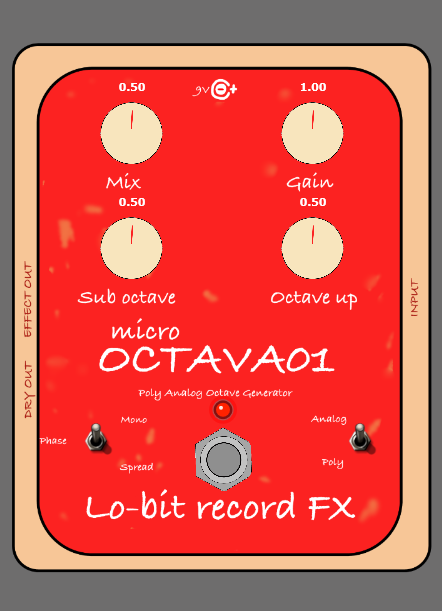
From Jimi Hendrix’s searing solos through the Roger Mayer Octavia to modern alternative rock anthems shaped by the Electro-Harmonix POG (Polyphonic Octave Generator) series, octave pedals hold a unique position in audio production.
Generating authentic musical pitches one octave above or below an instrument’s incoming signal requires radically different engineering topologies depending on whether the source is monophonic or polyphonic.
This technical study explores the circuit physics of legacy analog rectification, the mathematical principles of digital phase-vocoder chord tracking, and the dual-mode architecture behind micro OCTAVA01.
1. Analog Circuitry: Full-Wave Rectification and Flip-Flop Dividers
Legacy analog pedals generated octaves entirely through hardware components.
① Octave-Up via Full-Wave Rectification
By routing an alternating current audio signal through a transformer-coupled diode bridge, the negative half-cycles are folded into positive values:
$$y(t) = |x(t)|$$
For a sinusoidal fundamental frequency $f_0$, full-wave rectification cancels the odd fundamental and produces a waveform dominated by $2f_0$ (one octave up), combined with rich odd-order clipping harmonics—creating the iconic snarling fuzz associated with vintage Octavia circuits.
② Octave-Down via Flip-Flop Division
Sub-octaves were generated by converting the signal into a square wave via Schmitt triggers and passing it through a digital D flip-flop binary divider, halving the frequency.
⚠️ The Monophonic Limitation:
Because analog dividers rely on zero-crossing detection, feeding chords into them causes chaotic phase-jumping and severe glitching.
2. Digital Evolution: Polyphonic Spectral Tracking
The Electro-Harmonix POG broke this barrier by utilizing real-time digital signal processing based on the Short-Time Fourier Transform (STFT) and Phase Vocoder algorithms:
[Input Signal] ──> [STFT Windowing] ──> [Instantaneous Phase Extraction] ──> [Spectral Scaling (×0.5 / ×2.0)] ──> [Inverse STFT] ──> Polyphonic Output
By transposing frequency bins in the spectral domain, complex jazz chords and fingerpicked acoustics track cleanly without pitch warbling or glitching.
3. The Dual-Engine Hybrid Architecture
While polyphonic digital tracking is essential for full chords, monophonic analog modeling remains sonically superior for bass punch:
- Poly Mode: Ideal for chords and atmospheric pads, but introduces slight algorithmic buffering latency.
- Analog Mode: Monophonic only, but delivers zero-latency sub-bass impact with massive fundamental weight.
micro OCTAVA01 combines both into an instantaneous toggle:
Analog Mode: Prioritizes raw monophonic transient speed and heavy sub-kick punch.Poly Mode: Delivers pristine, artifact-free chord tracking for multi-string textures.
4. Intelligent Stereo Spatial Spread
A frequent issue with octave stompboxes is phase cancellation caused by wide sub-bass dispersion.
micro OCTAVA01 features an integrated Stereo Spread circuit:
- Sub-Octave: Locked strictly to the center (Mid channel) to ensure mono compatibility on large club sound systems.
- Upper-Octave: Spreads outward into the Side channel with subtle psychoacoustic detuning, creating a massive stereo wall of sound without cluttering the center lead vocal.
5. Real-World Guitar A/B Audio Comparison
Listen to the audio comparison below recorded with micro OCTAVA01 on an electric guitar track. Experience the difference between the clean bypass tone and the rich octave harmonics:
*Tracks created using the environments, gear, and techniques featured on this site are available for preview and free download in the Lo-bit LAB Free BGM Library. Continuously updated.*
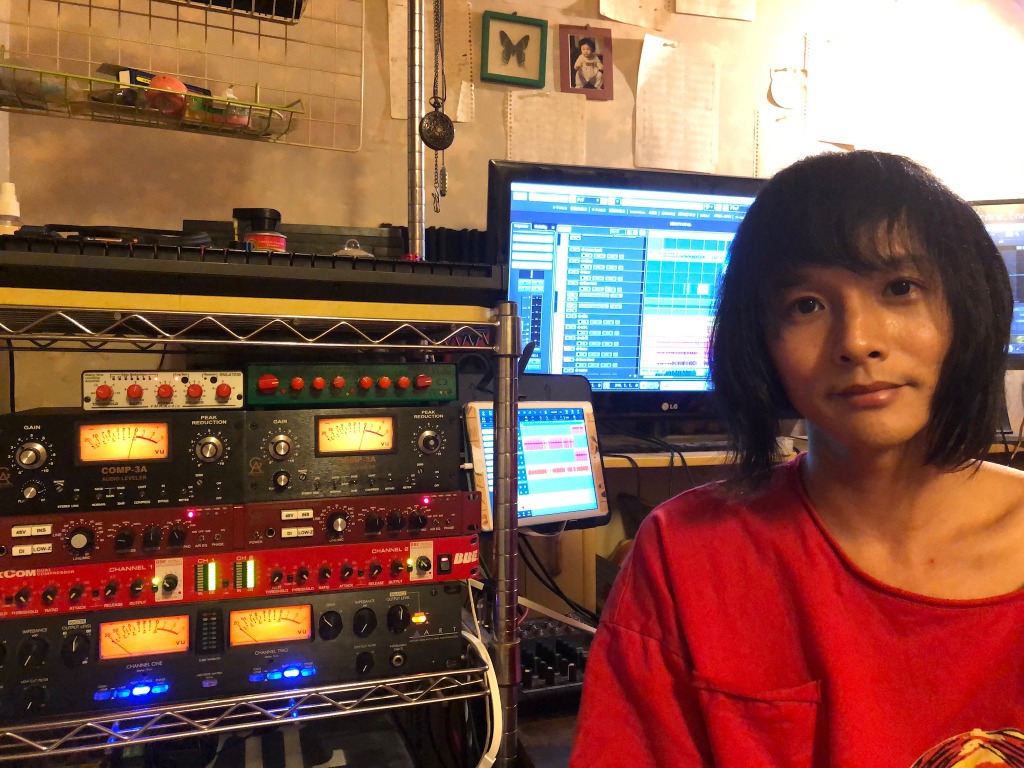
Lin Wolinski / Lo-bit record
Musician, Recording & Mixing Engineer, Music Instructor (Guitar, Bass, DTM, Composition & Arrangement), and C++ Audio DSP Plugin Developer.
Active as Bassist, Synthesist, Backing Vocalist, and Composer/Arranger for the rock band "Once Grace Forever".
Following musical study in Australia, actively engaged in professional music production, bespoke mixing & mastering, boutique audio plugin development under "Lo-bit record", releasing royalty-free music assets, and authoring audio engineering resources.