
Precision Mixing: Resolving Frequency Masking with 8-Band Dynamic EQ and External Sidechain Ducking
How to resolve low-end clashes between kick and bass and clear mid-range vocal masking without tonal thinning, combining dynamic filtering with Tube, Tape, and Transistor analog saturation.
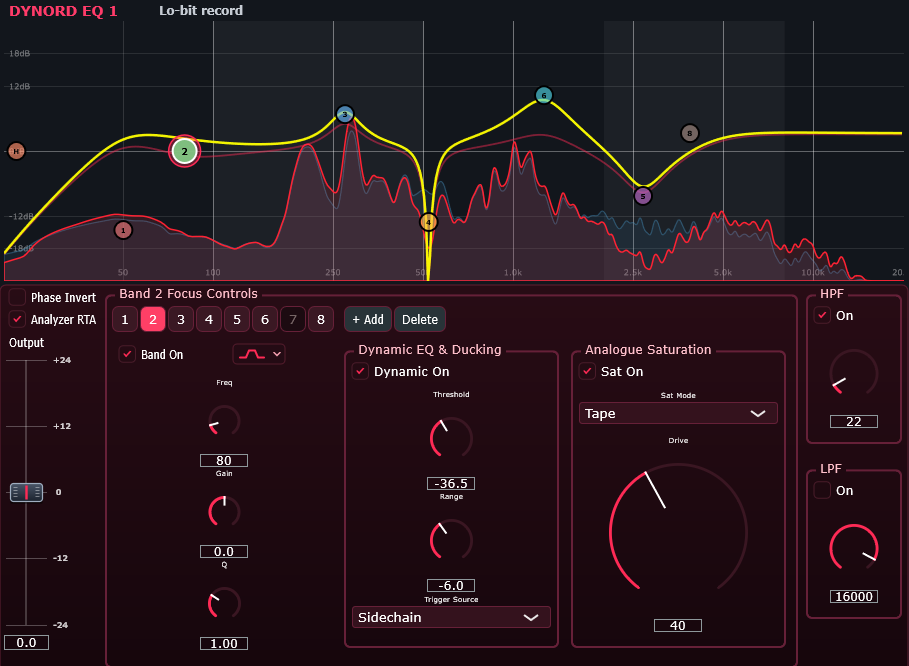
In modern audio engineering, frequency masking remains one of the primary hurdles to achieving a clear, commercially competitive mix.
Masking occurs when concurrent audio elements share overlapping spectral energy—most notoriously between the kick drum and bass, or lead vocals and electric guitars/synth pads. When played simultaneously, the human auditory system prioritizes the louder transient, rendering the other element muddy or indistinct.
Attempting to fix masking with static parametric EQ permanently guts vital frequencies across the entire track. This article examines the acoustic advantages of an 8-band dynamic EQ (the core design behind Dynord EQ 1) and details surgical external sidechain workflows.
1. Static EQ vs. Dynamic EQ: Architectural Differences
| Characteristic | Static Equalizer | Dynamic Equalizer |
|---|---|---|
| Gain Behavior | Fixed dB boost/cut at all times | Envelope-driven gain reduction/expansion |
| Tonal Impact | Permanently thins track when elements are not clashing | Operates strictly when threshold is breached |
| Phase Coherence | Constant phase shift introduced | Zero phase alteration during inactive periods |
Why Dynamic EQ Surpasses Multiband Compression
Multiband compressors split the full spectrum into discrete frequency bands using crossover filters (typically 4th-order Linkwitz-Riley), introducing phase smearing even when no compression is occurring.
A dynamic EQ utilizes independent parametric biquad filters that modulate gain dynamically without segmenting the entire frequency continuum, preserving transient integrity and acoustic clarity.
2. External Sidechain Ducking: Kick vs. Bass Precision
The most powerful application of dynamic equalization is targeted frequency-specific sidechain ducking.
De-cluttering the 50Hz–80Hz Region
- Insert the 8-band dynamic EQ on the bass track.
- Place an active band at 65Hz (or the kick drum’s primary fundamental frequency).
- Set the sidechain detector input to the external Kick track.
- Select Dynamic Cut mode and dial in the threshold to yield 2dB–4dB of attenuation.
[Kick Drum Hits]  ──> [Sidechain Trigger] ──> Bass Ducks by 3dB at 65Hz ONLY
[Kick Finishes]   ──> [Immediate Recovery]──> Bass Instantly Returns to Full 65Hz Weight
Unlike traditional broad-band sidechain compressors that audibly pump the entire bass track, frequency-targeted ducking allows the sub-bass foundation to remain rock solid while giving the kick drum surgical room to punch through.
3. Analog Modeling Saturation Stages (Tube / Tape / Transistor)
Surgical digital filtering can sometimes leave a track feeling sterile. Dynord EQ 1 counteracts this by integrating three switchable analog saturation engines:
- Tube Mode: Generates warm 2nd-order even harmonics, reinforcing low-mid chest resonance in vocals and acoustic instruments.
- Tape Mode: Introduces subtle high-frequency compression and smoothing, ideal for taming abrasive digital synth stacks.
- Transistor Mode: Imparts fast odd-harmonic edge, helping snare cracks and basslines cut through low-fidelity mobile phone speakers.
*Tracks created using the environments, gear, and techniques featured on this site are available for preview and free download in the Lo-bit LAB Free BGM Library. Continuously updated.*
Lin Wolinski / Lo-bit record
Musician, Recording & Mixing Engineer, Music Instructor (Guitar, Bass, DTM, Composition & Arrangement), and C++ Audio DSP Plugin Developer.
Active as Bassist, Synthesist, Backing Vocalist, and Composer/Arranger for the rock band "Once Grace Forever".
Following musical study in Australia, actively engaged in professional music production, bespoke mixing & mastering, boutique audio plugin development under "Lo-bit record", releasing royalty-free music assets, and authoring audio engineering resources.