Plate Reverb DSP: Physical Dispersion of the EMT 140 and 12AU7 Vacuum Tube Saturation
A technical study examining modal density in thin steel plates, frequency dispersion modeling, 12AU7 dual-triode harmonic excitation, and the acoustic integration of vintage VCA gated expansion.
In the evolution of artificial reverberation, the plate reverb occupies an irreplaceable sonic territory. Developed in 1957 by Germany’s Elektromesstechnik (EMT), the monumental EMT 140 utilized a suspended cold-rolled steel plate weighing over 200kg, driven by electro-dynamic transducers to generate an extraordinarily dense, shimmering metallic tail unattainable in natural rooms.
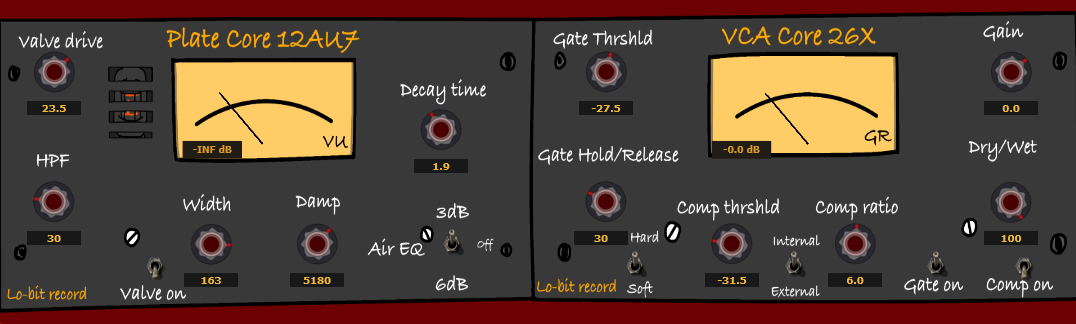
This article explores the mathematical modeling of physical wave dispersion in steel plates, the warm harmonic non-linearities of 12AU7 dual-triode tubes, and the DSP integration of envelope-following VCA gating (the core architecture of Plate core 12AU7).
1. Physical Acoustics of Plate Reverb: Modal Density and Wave Dispersion
In conventional three-dimensional acoustic enclosures (concert halls and rooms), reflection density increases proportionally to the square of time ($t^2$).
In contrast, flexural waves propagating across a two-dimensional metallic sheet (0.5mm to 1mm thick) display a modal density that is fundamentally uniform with respect to frequency.
The Mechanism of Frequency Dispersion
The phase velocity $c_p$ of flexural bending waves in a thin elastic plate is frequency-dependent:
$$c_p = \sqrt{\omega} \cdot \left(\frac{E \cdot h^2}{12 \cdot \rho \cdot (1 - \nu^2)}\right)^{1/4}$$
- $E$: Young’s modulus of elasticity
- $h$: Thickness of the plate
- $\rho$: Mass density
- $\nu$: Poisson’s ratio
This physical relationship demonstrates that high-frequency wave components propagate faster through the steel sheet than low-frequency components. This phenomenon—frequency dispersion—is the physical reason behind the bright, immediate transient attack and silky smooth decay characteristic of true plate reverberation.
2. 12AU7 Dual-Triode Non-Linear Saturation
The earliest iterations of the EMT 140 utilized dedicated vacuum tube electronics (such as the V83 amplifier).
In Plate core 12AU7, we integrated a physical circuit simulation of the 12AU7 (ECC82) dual-triode tube directly into the pre-delay and drive stages. The 12AU7 possesses a moderate voltage amplification factor ($\mu \approx 17$), yielding an exceptionally wide headroom band where musical 2nd and 3rd-order harmonic overtones are continuously generated before hard clipping occurs.
[Digital Audio Input] ──> [12AU7 Non-Linear Tube Drive] ──> [Plate Dispersion Network] ──> [Silky Reverb Tail]
Why Place Tube Drive Ahead of the Reverb Network?
Feeding raw, sterile digital samples or clicky drum transients directly into a high-density reverb network often exacerbates harsh high-frequency ringing. By introducing gentle 12AU7 soft-saturation prior to reflection diffusion, initial signal spikes are musically rounded, enabling the ambient tail to anchor deeply into the background of a dense mix.
3. VCA Gated Reverb: From 80s Power Snares to Modern Vocal Throws
In the early 1980s, producer Hugh Padgham and Phil Collins revolutionized pop production with the gated snare.
Traditionally, recreating this effect required tedious sidechain bus routing to an external noise gate. In Plate core 12AU7, an envelope-following VCA expander circuit is directly wired into the output stage of the plate algorithm:
[Plate Reverb Signal] ──> [Voltage-Controlled Amplifier (VCA)] ──> [Output]
                                  ▲
[Envelope Detector] ──────────────┘ (Threshold, Attack, Hold, Release)
Contemporary Production Applications
- 80s Gated Snare: Set decay time to 3.5s with a Gate Hold of 140ms and fast 50ms Release. Creates a massive acoustic explosion that cuts off instantly, maintaining percussive precision.
- Modern Trap Vocal Throws: Apply deep plate decay to trailing vocal syllables while using the gate to sever the tail the moment the next vocal line enters, keeping the low-mid groove clean and uncluttered.
*Tracks created using the environments, gear, and techniques featured on this site are available for preview and free download in the Lo-bit LAB Free BGM Library. Continuously updated.*
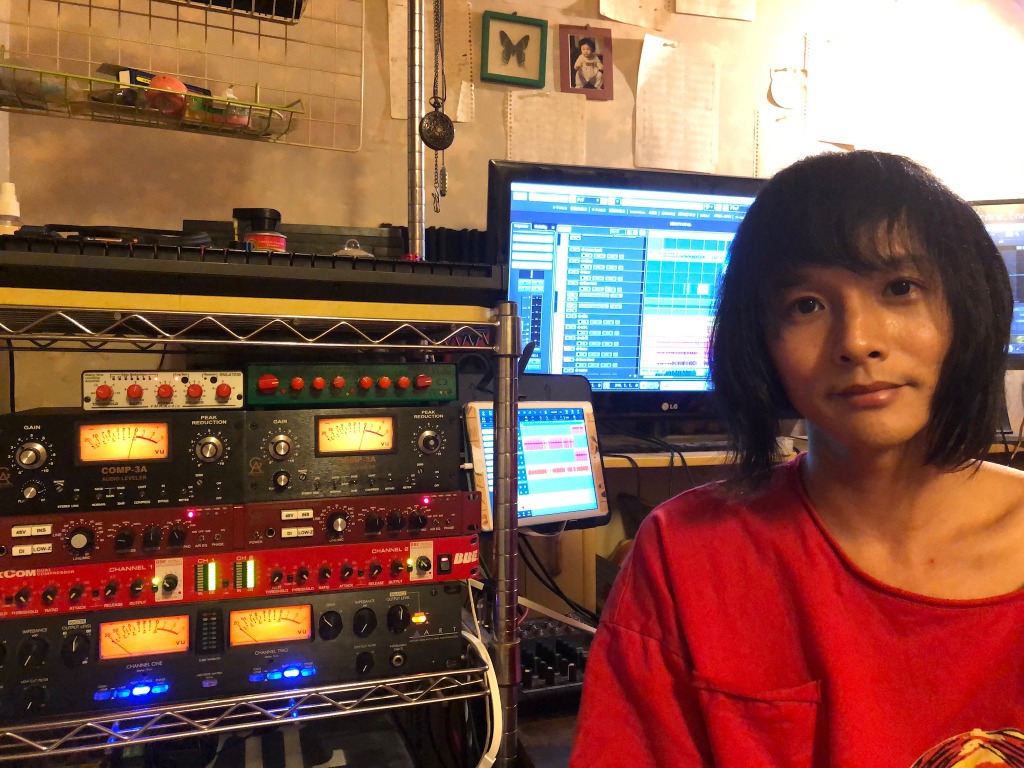
Lin Wolinski / Lo-bit record
Musician, Recording & Mixing Engineer, Music Instructor (Guitar, Bass, DTM, Composition & Arrangement), and C++ Audio DSP Plugin Developer.
Active as Bassist, Synthesist, Backing Vocalist, and Composer/Arranger for the rock band "Once Grace Forever".
Following musical study in Australia, actively engaged in professional music production, bespoke mixing & mastering, boutique audio plugin development under "Lo-bit record", releasing royalty-free music assets, and authoring audio engineering resources.