Modern Mastering Theory: Inter-Sample Peak Dynamics and EBU R128 / ITU-R BS.1770 LUFS Metering
A technical guide covering the physical origins of Inter-Sample Peaks (ISP), K-weighting loudness measurement filters, and the DSP implementation of True Peak brickwall limiting with TPDF dither.
In the contemporary era dominated by streaming platforms such as Spotify, Apple Music, YouTube, and Tidal, the paradigms of the historic “Loudness War” have been rewritten.
Squashing audio to maximum sample peak amplitude no longer produces a competitively louder master. Instead, platform-wide loudness normalization algorithms aggressively attenuate over-compressed files, while lossy codec transcoding (AAC, Ogg Vorbis) induces harsh inter-sample clipping artifacts.
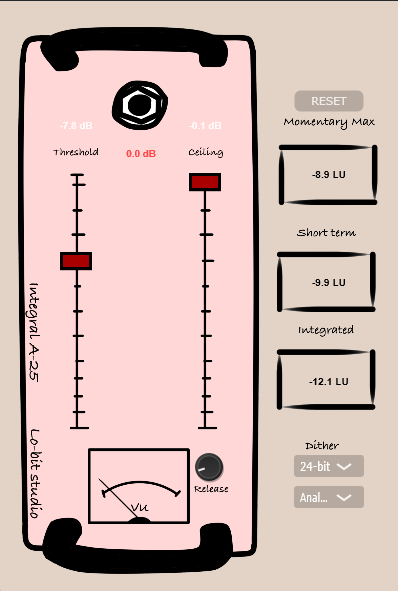
This article details the psychoacoustic algorithms behind the ITU-R BS.1770 and EBU R128 standards and explains the DSP architecture behind True Peak brickwall limiting (the engineering core of Integral A25).
1. The Physics of Inter-Sample Peaks (ISP)
Even when a DAW peak meter indicates a ceiling of 0.0 dBFS, severe analog clipping can still occur inside the listener’s Digital-to-Analog Converter (DAC).
Digital audio is composed of discrete points in time. When a DAC reconstructs a continuous analog waveform using sinc interpolation, the analog curve between two consecutive sample points can swing significantly above the discrete sample values.
Digital Samples:          * (0.0 dBFS)               * (0.0 dBFS)
                               \                   /
Reconstructed Waveform:         \   ▲ (+1.5 dBTP) /   <── Clipping in Analog Stage!
                                 \ /           \ /
To eliminate these invisible overshoots, True Peak limiters execute 4x (or 8x) polyphase upsampling, calculating the reconstructed analog trajectory with extreme precision before applying gain reduction.
2. Demystifying LUFS: K-Weighting and Measurement Windows
Unlike antiquated RMS meters, LUFS (Loudness Units relative to Full Scale) evaluates perceived loudness by filtering signals through an empirical model of the human auditory system.
The Two-Stage K-Weighting Filter (ITU-R BS.1770)
- Stage 1 (Head-Acoustic Pre-Filter): A high-shelf filter boosting frequencies above 2kHz by ~+4dB to simulate cranial diffraction and ear canal resonance.
- Stage 2 (RLB High-Pass Filter): A 2nd-order high-pass filter cutting frequencies below 100Hz to reflect the human ear’s diminished sensitivity to extreme sub-bass at equal energy levels.
The Three Essential Windows
- Momentary LUFS (400ms): Reflects immediate dynamic bursts (e.g., impact of a chorus).
- Short-Term LUFS (3s): Evaluates structural section-to-section dynamics.
- Integrated LUFS (Entire Song): The comprehensive gated program loudness that streaming platforms read to apply gain normalization.
3. Streaming Targets and the -1.0 dBTP Rule
| Platform | Integrated LUFS Target | Recommended Ceiling |
|---|---|---|
| Spotify | -14.0 LUFS | -1.0 dBTP (for louder masters) |
| Apple Music | -16.0 LUFS | -1.0 dBTP |
| YouTube | -14.0 LUFS | -1.0 dBTP |
| Club / CD | -9.0 to -7.0 LUFS | -0.1 to -0.3 dBTP |
💡 Why Set True Peak to -1.0 dBTP?
When uncompressed WAV masters are converted to lossy streaming formats (like AAC 256kbps or Ogg 320kbps), transient peaks typically expand by 0.5dB to 0.8dB due to band-limiting and quantization filters. A -1.0 dBTP ceiling provides the essential safety margin to prevent digital distortion on consumer playback devices.
4. TPDF (Triangular Probability Density Function) Dither
When truncating 24-bit or 32-bit floating-point mixes down to 16-bit distribution media, directly lopping off the lower bits generates quantization distortion—non-linear distortion mathematically correlated to the music.
Applying TPDF dither (adding two independent uniform random noise signals) randomizes the quantization error, turning correlated harmonic distortion into a benign, stationary white noise floor and preserving decay detail down into silence.
*Tracks created using the environments, gear, and techniques featured on this site are available for preview and free download in the Lo-bit LAB Free BGM Library. Continuously updated.*
Lin Wolinski / Lo-bit record
Musician, Recording & Mixing Engineer, Music Instructor (Guitar, Bass, DTM, Composition & Arrangement), and C++ Audio DSP Plugin Developer.
Active as Bassist, Synthesist, Backing Vocalist, and Composer/Arranger for the rock band "Once Grace Forever".
Following musical study in Australia, actively engaged in professional music production, bespoke mixing & mastering, boutique audio plugin development under "Lo-bit record", releasing royalty-free music assets, and authoring audio engineering resources.