
Vocal Engineering: Mastering Split-Band De-Essing Between 4kHz and 10kHz Without Choking Vocal Air
How to transparently tame harsh vocal sibilants ('S', 'T', 'Sh') while preserving breath and high-frequency air, exploring wideband vs split-band architectures and preventing unnatural lisping.
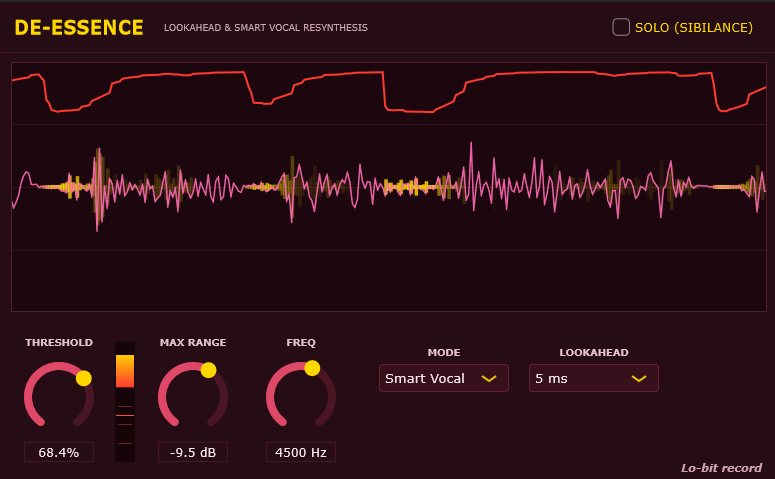
In vocal production, nothing differentiates an amateur home demo from a polished commercial record more decisively than sibilance control.
Consonants like “S”, “T”, “Ch”, and “Sh” concentrate immense, spike-like acoustic energy between 4kHz and 10kHz. In contemporary pop, hip-hop, and modern metal, vocals are routinely boosted in the top end (10kHz–16kHz air band) and driven hard into fast peak limiters. Without meticulous treatment, harsh sibilants turn razor-sharp, inducing rapid listener fatigue.
This article details the acoustics of vocal sibilance, compares wideband vs. split-band DSP filtering, and explores the architecture behind DeEssence.
1. Wideband vs. Split-Band De-Essing
Traditional de-essing processors function via one of two distinct topologies:
① Wideband De-Essing
- Mechanism: When high-frequency sibilance exceeds the threshold, the plugin ducks the entire frequency spectrum of the vocal track.
- Flaw: Audibly ducks the underlying vowel fundamentals and low-mid warmth, causing unnatural volume flutter on consonant transitions.
② Split-Band De-Essing
- Mechanism: An internal crossover isolates the problem zone (4kHz to 10kHz). Attenuation is applied strictly to the sibilant band, leaving the low-mid body untouched.
[Vocal Input] ──┬──> [Low/Mid Band (< 4kHz)] ───────────────────────────────┐
                │                                                           ├──> [Recombined Output]
                └──> [High Sibilant Band (4k–10kHz)] ──> [Gain Reduction] ──┘
                             ▲
[Lookahead Detector] ────────┘
2. Preventing the Unwanted “Lisp”
The most common pitfall in vocal de-essing is the “lisping effect,” where clean “S” sounds turn into muffled “Th” sounds.
The Three Root Causes of Lisping
- Bandwidth Too Wide: Clamping down below 3.5kHz, choking the vocal’s core intelligibility and presence.
- Sluggish Release Time: Failing to release attenuation before the singer transitions into the subsequent open vowel.
- Static Notch Filtering: Carving out high frequencies permanently, even during non-sibilant phrases.
DeEssence resolves this through an ultra-fast lookahead detection network paired with a rapid, program-dependent release curve. Attenuation strikes the transient burst within fractions of a millisecond and releases instantaneously as open vowels form.
3. Comparison with Waves Sibilance
Waves Sibilance is renowned worldwide for its organic, transparent curve. DeEssence shares this smooth, spectral-natural reduction envelope, ensuring the breathy air of the vocal remains unchoked.
However, when working with harsh budget condenser microphones or aggressive rap/rock vocals, engineers frequently encounter a key limitation: insufficient maximum reduction range.
DeEssence was specifically engineered with an expanded authoritative threshold and linear reduction depth, allowing engineers to command -12dB or more of transparent reduction without dulling the vocal’s perceived brilliance.
*Tracks created using the environments, gear, and techniques featured on this site are available for preview and free download in the Lo-bit LAB Free BGM Library. Continuously updated.*

Lin Wolinski / Lo-bit record
Musician, Recording & Mixing Engineer, Music Instructor (Guitar, Bass, DTM, Composition & Arrangement), and C++ Audio DSP Plugin Developer.
Active as Bassist, Synthesist, Backing Vocalist, and Composer/Arranger for the rock band "Once Grace Forever".
Following musical study in Australia, actively engaged in professional music production, bespoke mixing & mastering, boutique audio plugin development under "Lo-bit record", releasing royalty-free music assets, and authoring audio engineering resources.